How do our everyday financial choices connect to love of neighbor, care for creation, and the kind of world we hope to help build? Ahead of Faith and Money Network’s upcoming webinar with theologian and ethicist Dr. Cynthia Moe-Lobeda, we spoke with her about seeing our economic lives more clearly — and finding faithful, hopeful pathways toward greater generosity, justice, and shared flourishing.
Brittany Wilmes, Faith and Money Network: I want to start off with the connection you make between love of neighbor and our economic life. Jesus talks about economies all the time in the Gospels, especially the dangers of money, but often Christians don’t naturally connect neighbor love to economies. Tell me more about this concept.
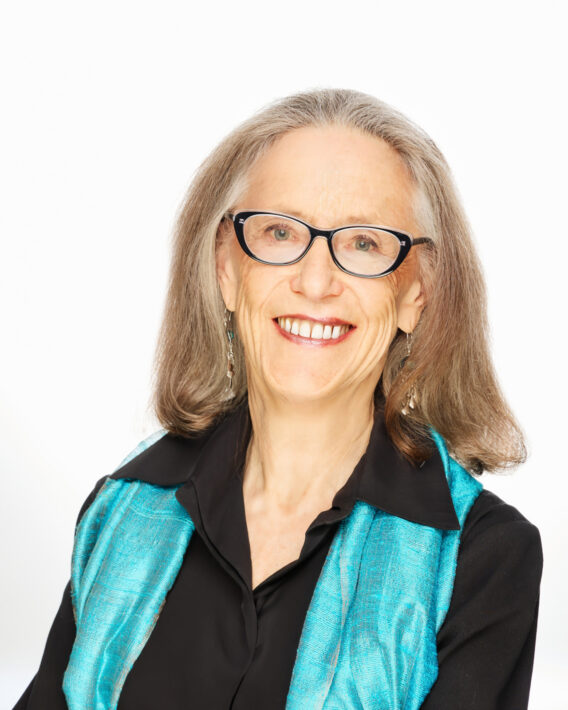
Dr. Cynthia Moe-Lobeda, Pacific Lutheran Theological Seminary: That connection was blazed into my soul when I was about 14, and I saw a film in my church youth group about the brutal exploitation of plantation workers in the Caribbean by the corporations that produce our fruit and sugar. It blew my mind. I began exploring other such connections, and I realized that the products we use are connected to people worldwide. From my Christian faith perspective, anyone that your life impacts is a neighbor you’re supposed to love. Instead, I realized that in so many ways, that impact was damaging through our economic systems.
As a young adult, I served for two years as a missionary working in healthcare in Central America. There I saw the women I worked with giving birth to malnourished, underweight babies. They were so malnourished because their families needed a small piece of land on which to grow food, but the land around the village was owned by foreign corporations raising beef on it.
Years later, I was leading a delegation to Central America and Mexico. A strawberry picker told me, “Our children go hungry because this land grows strawberries. It should grow beans and corn for our children.” Jon Sobrino, the Jesuit priest, meeting in his office with a small delegation of U.S. citizens that I was leading in El Salvador, said, “In El Salvador, poverty means death, and people aren’t poor by chance. They’re poor because the systems that bring your wealth make them poor.”
In our own country, I got to know a woman living in my church’s shelter. She had lost her apartment because the company she worked for didn’t pay a decent enough wage. All of these experiences — and many more like them — built my sense that loving your neighbor and how you live your economic life are intimately connected.
Wilmes: Your work describes a moral economy as ecological, equitable and democratic. Why do those qualities matter, and what do they reveal about the kind of economy God calls us to help build?
Dr. Moe-Lobeda: To me, an economy is not a bunch of numbers. It is a web of relationships. It brings us into relationships with folks. As I understand it, God gave us two grand rules to guide how we structure our lives together in the household of God (the creation). The first thing God tells the human to do in Genesis 2:15 is to serve and preserve the garden. That leads to the ecological principle: an economy should enable Earth’s web of life to flourish.
Secondly, God says, “You will love your neighbor as yourself.” The prophets understand love to entail justice and building “right relationships” (righteousness) with others, especially with the vulnerable. This generates the second principle or guidepost for our economic lives: equitable. Our economies should be ecological, serving and preserving the garden, and equitable, building justice and right relationships among human beings.
The third principle is democratic. Power should be distributed among people, not concentrated in a few hands, and its exercise should be accountable to the people impacted. In the U.S., that principle has applied to political life and distinctly not to economic life. A democratic economy would say that distributed and accountable power also applies to the economy. We would work against policies that concentrate wealth in a few hands, because that concentrates power. And we would work for policies that require decision-makers to be accountable.
Those are the three principles of an economy for life, one that leaves behind extractive, exploitative capitalism: ecological, equitable and democratic.
Wilmes: People who come to Faith and Money Network are often grappling with having what feels like too much money or power. They may have received an inheritance or be thinking about what to do with their money as they age. How can Christians face the gap between their values and the choices available to them without falling into despair or overwhelm?
Dr. Moe-Lobeda: It’s easy to fall into despair about the complexity of economic systems and how money operates in the world. We need to be aware of the temptation to give up, saying, “I’ll do some good things with my money, but I won’t pay attention to the systemic injustice my money is involved in, and the suffering that such injustice causes.”
There’s a little voice that whispers, “There’s nothing you can do about systems of injustice. They’re too big.” I call that the devil’s lie. Economies are human systems, created by human decisions and actions. Anything built by human beings can be unbuilt, and something else built instead. But human agency in the face of systems requires collective action. I’m not an “I”; I’m a “we.” It helps to realize that we can be players in the vast movement of people around the world working toward more equitable, ecological, democratic economies.
I ask people to remember three terrains of action: personal lifestyle practices, systems, and worldviews or grand narratives. With personal practices, I can watch what my money does. I can move my savings or investments out of banks fueling fossil fuels or speculative investment and put them in socially responsible, locally controlled institutions that reinvest in the community. My husband and I did that decades ago.
With systems, I can use money to support tax justice, candidates working for equity and economic justice, or efforts to get my church, denomination or university to divest from fossil fuels. Those are deeply personal efforts to change systems.
Worldview is how we think and perceive the world, and theology plays a role. We’ve been brought up to think of Earth’s waters, trees, lands, soils and air as resources for humans to profit from. What if we rethought the Earth through a biblical lens? Earth is not just the stage on which the drama between human beings and God takes place. In Genesis, God calls upon the Earth to be a co-creator. In Deuteronomy, God calls upon the mountains to witness. In the opening chapter of Paul’s letter to the Christians in Rome, we learn that creation has been knowing and understanding God since the beginning of time! We’d better start listening to the Earth.
It’s a grand human adventure to work toward what the World Council of Churches calls “economies for life.” We can serve that work through personal choices, systems change and worldview change. And we can invest our money in those efforts.
Wilmes: I love that sense of adventure. This can be generative and imaginative work. At Faith and Money Network, we often begin by asking people to write a money autobiography: Where did you learn about money? What did your parents or church teach you? Because of the way they were raised, people often have a narrow, black-and-white view of how they should handle money, rather than thinking expansively.
Dr. Moe-Lobeda: It’s easy to think economic justice work is arduous or unfun. But one could say it’s a wild adventure. What would it look like to live in an economy where all people had housing? Or to go to a grocery store and know the people who produced the food were paid right and weren’t poisoned by agro-industrial chemicals? To say, “There’s life behind this food,” rather than, “There’s exploitation behind this food.”
That pertains to more than food. The brutality against people, including Indigenous peoples, where minerals for our electronics are mined is devastating. In an economy for life, we would consume less and have laws so that companies could not produce goods from minerals mined by eight-year-old boys in the Democratic Republic of the Congo. In an economy for life, those children would be in school, not forced into dangerous mines.
There’s something beautiful about being part of building a different world, even if it won’t happen fully in my lifetime. Economic change is also essential to addressing climate change. The form of economy that enables the fossil fuel industry to maximize profit is going to destroy our habitat, our home. Resisting and changing that can be a life-giving calling.
One of my mentors, the late Beverly Wildung Harrison, said something like, “Align yourself with ways that build the reign of God on earth, and you’ll find yourself in a marvelous company of friends.”
Wilmes: And she was right.
Dr. Moe-Lobeda: The relationships built in working toward economies for life are life-giving. I’ve learned so much from people in the Pacific Islands and from Indigenous folks here resisting mining industries on their lands. Human relationships are worth more than gold, and we can build good ones in this effort.
Wilmes: Where might someone look for community around this work? What was it like for you to find people working toward a new economy?
Dr. Moe-Lobeda: When I first entered this work after seeing that film, I became an activist as a high school kid. But I was very alone in my perceptions. My friends and parents didn’t get it. On a deep level, I had no one I could honestly spill my heart to who understood. That drove me into years of despair and self-hatred. I worked my way out of that by the grace of God and the Spirit working through other human beings. We need community.
It can start with sharing our concerns and grief. In my class, Building Moral Economies, we begin by asking what people fear or grieve about economic life and who they know who’s been damaged by the economy as we know it. People start sharing life stories. That’s a good place to begin.
Another step is to find people locally whose aims around economic justice meet yours. It might be housing or water justice, or asking how a church food bank can not only give food but help change the conditions making people poor.
You can also connect with your faith community and broader efforts. I’m Lutheran, so I might connect with the Lutheran World Federation and learn about its work in the NIFEA Initiative (New International Financial and Economic Architecture). The World Communion of Reformed Churches is also involved in NIFEA. Or one can connect through global climate efforts such as 350.org or GreenFaith. Build community with people close to you, with local efforts and with broader global efforts. Then you can say, “I’m not just an individual trying to do good with my money. I’m part of a cloud of witnesses.”
Wilmes: I was also thinking about spiritual practices that can help people approach financial decisions in keeping with their faith and values.
Dr. Moe-Lobeda: One spiritual practice I have is a daily “beauty bath,” and I invite my students also to adopt this practice. It is to take a moment — even a minute or two — to savor some dimension of beauty in front of you. It might be the air caressing your face, the colors of the sky or a stranger’s face. We are surrounded by so much beauty! It reminds me what an incredible gift it is to be alive on Earth right now.
I also remind myself each morning that being alive is precious, rare and infinitely meaningful. In our time, people committed to the greater good are needed. We’re at a turning point: one direction leads toward climate-induced catastrophe of a magnitude that is almost unimaginable. The other toward economies and societies that enable Earth’s web of life — including we human beings — to flourish. Every person in Faith and Money Network can help shape which way we go.
I once saw a flock of birds flying resolutely in one direction as though it were the only way to go. Then, suddenly with a graceful swoop, they veered off in the opposite way. How, I wondered, did they manage that radical re-direction? Well, if birds can do it, humans can do it, too. That’s the kind of change we need today. It’s a grand calling to be part of that swoop.
Wilmes: What do you hope people who attend our webinar next month will carry with them?
Dr. Moe-Lobeda: I hope they carry a deep sense that they have moral and spiritual power to live toward life-giving economies in their everyday lives, particularly through their money and time. I hope they find joy and meaning in that.
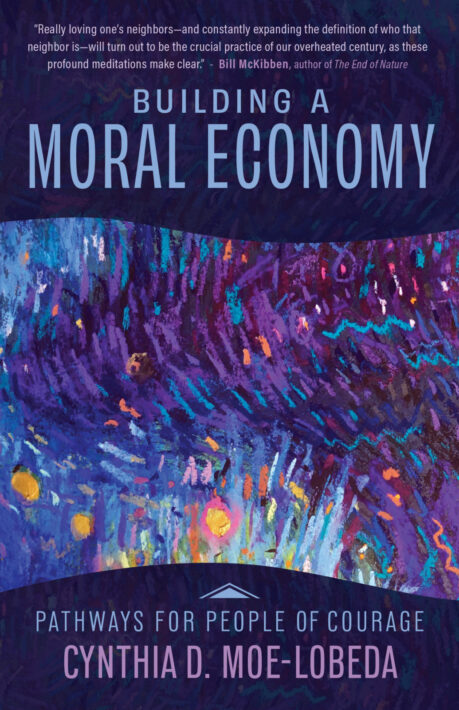
I’d also be thrilled if people read Building a Moral Economy and the series it introduces. The series has five additional books, and people can learn about it at buildingamoraleconomy.org.
Wilmes: Is the second book out yet?
Dr. Moe-Lobeda: Yes. Climate Justice, Climate Hope and A Home for All are out, and Water for All will be out in a little less than a month. The books are written by authors from activist, faith and academic communities. Except for mine, they’re intentionally small books of around 100 pages. They’re reader-friendly and centered on stories of real people doing real things. One aim is to introduce readers to the cloud of witnesses working toward economies for life. So I encourage people to have a look at that website, and then order the books and dig into them.
Learn more about our October 28 webinar with Dr. Moe-Lobeda and register now!