“Sabbath means the recentering of human life on being rather than doing. That is hugely important in a culture like ours where most of us get our identity from what we do, from the job we have, from the money we spend, from the stuff we buy, from the way we change the world.” — Ched Myers
In 1988, I went on my first silent retreat at Dayspring. I was in my mid-20s and relatively new to the Church of the Saviour. I was an intern member at Jubilee Church in the Samaritan Inns mission group with Dave Erickson, Killian Noe, and Hugh Hammit. Marjory Bankson led the retreat.
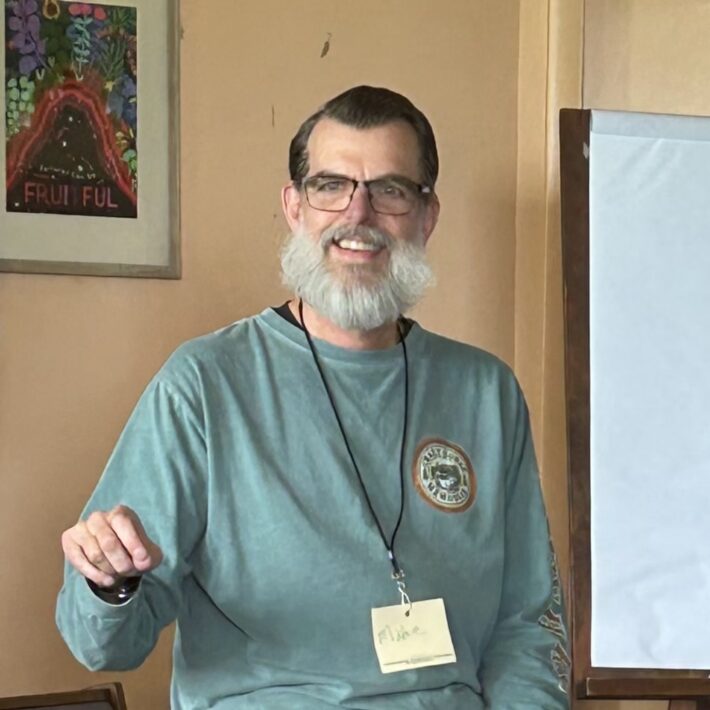
I can laugh at myself now, though I am still a little embarrassed looking back on that experience. I so wanted to impress the other retreatants with my spiritual IQ that I spent the entire weekend thinking about what great spiritual insight I was going to share when we broke the silence. I don’t remember what I shared, and I’m guessing no one else did either.
I am grateful for the elders in the group, who remained kind and inviting despite my obvious need for ego strokes and validation. Little did I know how important silence and our church’s daily prayer discipline would become to me and my spiritual growth. Perhaps the greatest gift this experience has given me is that of active presence. I would be surprised, 38 years ago, to hear myself say today that one of my favorite things to do is sit in shared silence.
I don’t think I could be a hermit; I love people, and I really love the energy of a group sharing silence. I always tell newcomers to silent retreats that the best way to get to know someone you don’t know is to share a weekend in silence, because you get to know their spirit first. As the joke goes, before they open their mouth and ruin it.
On that weekend retreat, I also never would have imagined having the opportunity to take a three-month sabbatical from work. I probably did not even know what a sabbatical was. However, this spring I was able to do just that, thanks to the Faith and Money Network board of directors.
During my sabbatical, I spent a lot of time reflecting on the practice of Sabbath. I agree with Hebrew Bible scholar Walter Brueggemann, who writes: “I have come to think that the fourth commandment on sabbath is the most difficult and most urgent of the commandments in our society today.”
The original definition of “sabbath” goes back to the Hebrew word shabbat, meaning to cease or to stop.
Land and other aspects of life were given rest periods as well as people. Rest was incorporated into the weekly rhythm. The significance of this stands today — sabbath offers space for reflection, renewal, and the kind of spiritual growth and vitality that can affect every decision we make.
In Jewish scriptures, the Sabbath (Shabbat) is mentioned dozens of times. It is a cosmic principle of Creation, formalized in the Ten Commandments, and upheld by the prophets as the sign of God’s eternal covenant with Israel.
The lesson is this: God rested on the 7th day not because God was tired, but to set a pattern for us to thrive. When God commanded the Israelites to keep the Sabbath in Deuteronomy, He reminded them that they were no longer slaves in Egypt. Slaves never get a day off; free people do.
And yet the Sabbath is not merely a day off to binge television or catch up on chores. It is a deliberate “ceasing” that makes space for us to feast on the presence of God through prayer, worship, and community. It is a time to build our relationships with God, others, and nature.
By pulling away from our daily labor, we intentionally open our weary hearts to receive the grace and soul-level rejuvenation that only God, only Divine Love, can provide. The gift is finding freedom in Sabbath rest.
Biblical scholar Ched Myers sums it up best. He writes: “Sabbath means the recentering of human life on being rather than doing. That is hugely important in a culture like ours where most of us get our identity from what we do, from the job we have, from the money we spend, from the stuff we buy, from the way we change the world. Sabbath suggests that who we really are, before God, is who we are, before God, aside from our production, aside from our consumption.”
The Gospels record numerous examples where Jesus intentionally withdrew from crowds and demanded even His disciples to pray in solitude. His habit of stepping away highlights the importance he placed on quiet, uninterrupted communion with God.
Even Jesus needed to get away from the crowds. Who or what are the crowds you need to get away from?
For me, it was work. Don’t get me wrong, I love my work. I will be starting my 20th year with Faith and Money Network this August. But I could tell last year that I needed a break, and I knew that the traditional vacation simply was not going to cut it.
Recognizing this need and mentioning it to some board members was a huge and healthy first step, but moving from feeling exhausted to actually planning a break can feel overwhelming. Doing this work in community is essential. Board members stepped up and encouraged me and were even excited for me. I will be forever grateful for the encouragement and their nudge that gave me the energy to follow through.
My intention for my sabbatical was, as Ched suggests, “To recenter my life on being rather than doing.” I gave a lot of thought to “who am I before God aside from my work, my production, aside from my consumption.”

My sabbatical offered me a profound opportunity to remember that my primary identity is rooted in God, not my performance or my relationships.
I love my job, I love being married to Victoria, and I love being a father. I love the Church of the Saviour. But my worth is anchored in the unchanging love of God. Rooting my identity in the Creator means my value cannot be altered by human opinions, successes, or failures. Stepping away helped me reconnect with the simple joys and experiences that had nothing to do with my roles.
I enjoyed some wonderful experiences during my time away from work. I started with a week of silence at a Trappist monastery. I spent ten days with friends in New Mexico, visited friends in South Carolina, and attended the Savannah Philharmonic. I had lovely lunches and coffees with friends. I learned from my daughter how to bake bread. I went to the driving range with my son and his friends to hit golf balls, which could have been an episode of America’s Funniest Videos.
But what was most surprising was how much I loved just being in the moment of daily life. I would often wake up in the morning giggling at how I could go back to sleep if I wanted to, or get up and read, then go back to sleep. Or take a walk, or eat a big breakfast. I had extended periods of morning prayer. I loved just “being” without any expectations.
At times, I was tempted by old, ingrained habits. One day I was driving back from a lunch with a friend and I noticed how fast I was driving. It hit me: Why am I in a hurry? I don’t have a meeting or anywhere to be! It was just a habit. So I slowed down, I let people cut in front of me, and I noticed just how frantic people were behind the wheel. I took a deep breath and enjoyed the rest of the ride home.
Our consumer culture is very powerful. We live in a culture that rewards burnout, treating busyness as a badge of honor. The constant hustle leaves our bodies exhausted and our souls disconnected. It insists that we are what we produce, buy, and accumulate. Modern life measures human value by efficiency, output, and net worth. When I struggled with old habits or inner critics, I realized just how powerful the consumer culture is in me.
I realize that not everyone can take three months off. I know how lucky I am to be able to have done so and to come back refreshed and grounded in the realization that my work is exactly what I am called to be doing. But a life of prayer and Sabbath doesn’t happen by accident; it happens by intention.
So here is my challenge to you: pick one block of time to shut off your screens, put down your to-do list, and simply sit in prayer. If you can take a whole day, sit for a day. If you can only start with one hour, start with an hour. Guard that time fiercely. It just might surprise you.
Mike Little | July 28, 2026
Mike Little is the executive director of Faith and Money Network. He lives in the D.C. metro area with his wife Victoria.